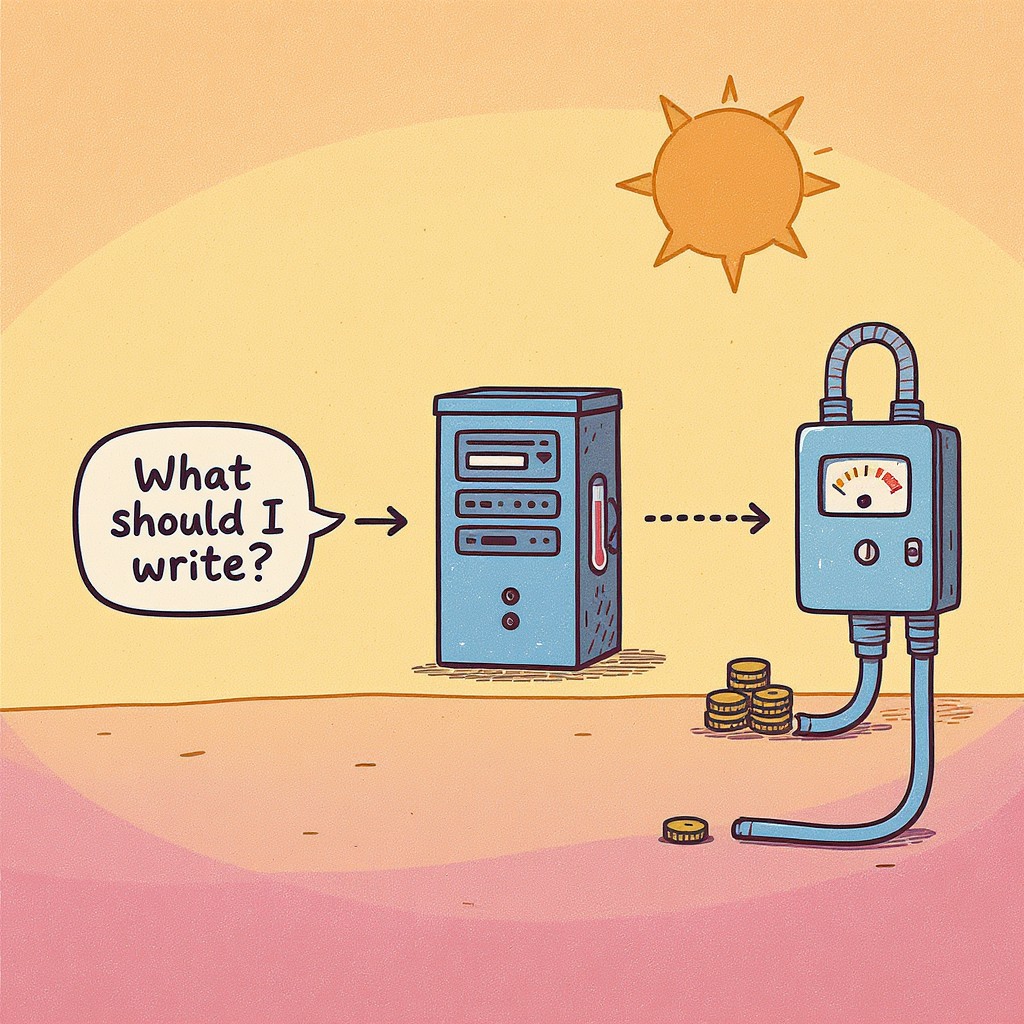
AI tools are getting slower. Prices are creeping up. Some features that were free last year are now behind a paywall. Others that were unlimited are now rate-limited.
If you have noticed this and wondered whether it was just you, it is not.
The constraint on AI development right now is not ideas, algorithms, or even compute in the abstract sense. It is electricity. Physical power. The kind that comes from grids, power plants, and cooling infrastructure that takes years to build. And that constraint is starting to show up in ways that affect solo creators and coaches directly.
Why this matters if you are not a tech person
You do not need to care about megawatts or data center construction to feel the effects. You just need to know that the AI tools you depend on are expensive to run, that cost is rising, and that pricing for the tools will reflect it.
Here is what that looks like in practice.
Subscription tiers that used to feel generous are getting tighter. Usage limits that felt theoretical are now ones people hit. Tools that were fast in 2023 are slower at peak hours in 2026 because demand has outpaced infrastructure. And the platforms charging $20 or $50 a month are under real pressure to either raise prices or reduce what that price buys.
This is not a reason to panic. It is a reason to use these tools more deliberately.
The math behind the slowdown
Every time you generate content, build an artifact, iterate on a draft, or run an image through an AI tool, it uses compute. Compute uses electricity. At scale, across millions of users, that adds up to something the grid was not designed for.
Major AI labs are currently in a race to secure power contracts, build their own data centers, and in some cases invest in energy generation directly. That is not a sign of a thriving, cost-efficient industry. That is a sign of a resource constraint being managed at enormous expense.
The cost of that constraint gets passed down. Not always as a straight price increase. Sometimes as slower response times. Sometimes as reduced context windows. Sometimes as features that quietly disappear from lower tiers. Sometimes as "fair use" limits that did not exist a year ago.
What this means for how you use AI tools
Use fewer tools, and use them well
Every platform you pay for is a bet that their infrastructure and pricing will stay stable. The more tools you stack, the more exposed you are to price changes across multiple platforms simultaneously.
Batch your generation
Running ten iterations in one session is more efficient than spreading them across the day. Not because of how you are billed necessarily, but because it forces you to think before you generate instead of defaulting to "let me just try this."
Brief before you generate
Every prompt that produces something unusable was compute spent for nothing. A five-minute brief that produces one usable draft beats twenty prompts that produce twenty mediocre ones.
Build on what you have
Regenerating from scratch is expensive in time and tokens. Getting something to 80% and refining it with a human pass is usually faster and cheaper than iterating AI output until it is perfect.
The bigger picture for coaches and creators
There is a version of this story that is alarming: AI is unsustainable, prices will spike, the tools you depend on will become unaffordable. That version exists and it is worth taking seriously.
There is also a more useful version: the coaches and creators who use AI efficiently and deliberately will be less affected by pricing pressure than the ones running endless generation loops. The efficiency habits that make your work better are the same ones that protect you from the worst of the cost increases.
This is one reason the AI Grimm approach leans on grounded workflows and clear briefs. Not just because the output is better. Because intentional use is also cheaper use. And in a world where electricity is the actual constraint, cheaper matters.
FAQ
Why are AI tools getting more expensive?
Running large AI models requires enormous amounts of electricity and specialized hardware. As demand grows faster than infrastructure, costs rise and platforms adjust pricing and limits to manage that.
Will AI tools become unaffordable for solo creators?
Possibly for some high-usage workflows. The more likely outcome is that free tiers shrink and paid tiers become the minimum for serious use. Deliberate, efficient use will matter more than it did when limits felt theoretical.
How does electricity relate to my AI subscription?
Every generation you run uses compute, which uses power. At scale, that cost is real. Platforms reflect it through pricing, limits, and feature decisions.
What can I do to reduce my AI usage costs?
Use fewer platforms. Write briefs before generating. Batch your work. Refine rather than regenerate. These habits reduce token and credit usage without reducing output quality.
Is this a reason to stop using AI in my business?
No. It is a reason to use it with more intention. The creators who build efficient workflows now will be better positioned as pricing evolves.
Thank you for reading. There is more on the blog whenever you are ready. And if you want to work through this alongside other coaches and creators, come and join us inside the community.