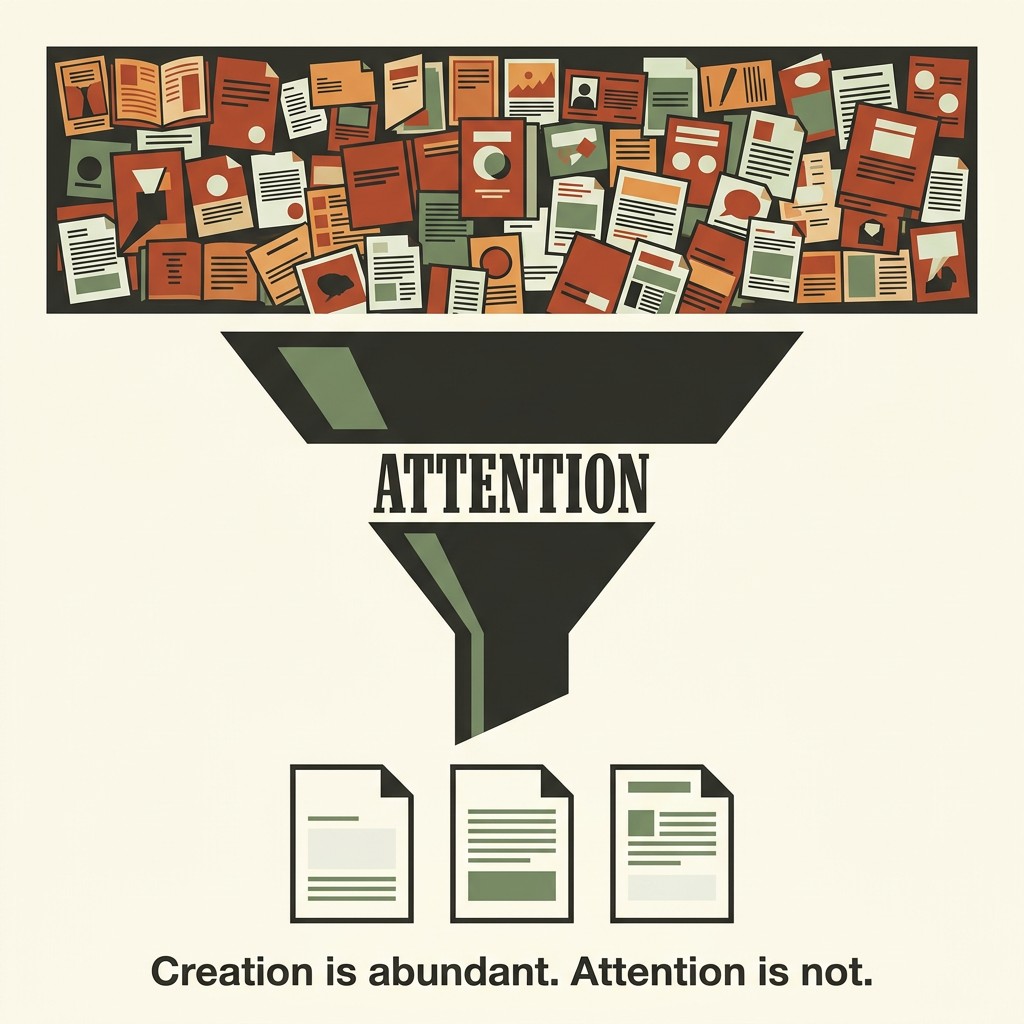
The production side of content has never been easier. The consumption side has not changed.
That imbalance is creating a real problem for coaches, creators, and anyone trying to build an audience through content. And it is accelerating faster than most people in the middle of their content calendar have stopped to notice.
What the boom actually looks like
A few years ago, creating a well-designed lead magnet, a structured email sequence, a useful client toolkit, or a short course required significant time, usually a team, and either design skills or the budget to hire someone with them.
Now a solo coach can produce all four in a weekend. That is genuinely remarkable. It is also happening simultaneously across every niche, in every market, at a scale that the available attention cannot absorb.
Every inbox has more in it. Every search result has more options. Every LinkedIn feed has more posts from more people who are all producing more. The feed is full. The downloads folder is full. The "I'll read this later" bookmark pile is taller than it has ever been.
Creation has scaled. Attention has not.
The supply-demand math nobody is talking about
The economics of content used to be constrained on the supply side. It was hard to create enough. Now the constraint has moved to the demand side. There is more than enough content. There is not enough attention to consume it.
When supply is constrained
Differentiation is easy. Your lead magnet stands out because there are fewer of them.
When demand is constrained
Differentiation is hard. Your lead magnet is competing with hundreds of others for the same thirty seconds of someone's morning.
The creators who built audiences in 2019 or 2021 did so in a different market than the one that exists today. The playbook that worked then - produce consistently, publish often, show up everywhere - is running into a wall. The wall is not that the advice is wrong. The wall is that it assumes attention is the variable. In 2026, attention is the constant and supply is the variable.
What actually cuts through
Specificity
The narrower the promise and the more precisely it describes the person it is for, the faster that person recognizes it as theirs. A guide "for coaches" disappears. A guide "for health coaches who have more knowledge than clients but have never sold anything beyond one-to-one hours" finds the right person immediately.
Usefulness over volume
One artifact that delivers a complete, specific outcome outperforms ten that promise something and deliver something slightly adjacent to it. The audience that uses what you make is the audience that trusts you. Volume does not build that trust. Usefulness does.
Shorter time-to-value
If your lead magnet requires forty minutes to read before the person gets the value, most people will not get the value. The attention crisis means the threshold for "worth my time" is higher than it used to be. Get to the value faster. Make the format match the promise.
The AI Grimm angle
This is directly relevant to why AI Grimm is built the way it is.
If the problem is generic content drowning in a noisy feed, the solution is not faster generic content production. It is content that is specific enough, grounded enough in your actual voice and materials, and useful enough for the precise person you are building it for.
AI that generates from your documents, your voice, your specific audience language is not a nice-to-have in 2026. It is the practical answer to an attention crisis that is getting worse, not better.
The creators who will continue to build trust and convert audiences are the ones who treat attention as the scarce resource it is. Every piece of content they produce should answer: does this earn the attention it is asking for?
FAQ
What is the attention crisis?
The growing gap between how much content is being produced and how much attention exists to consume it. Production has scaled with AI. Attention is fixed.
Does this mean content marketing is dying?
No. It means undifferentiated, generic content marketing is losing effectiveness. Specific, useful, audience-matched content still works. It always will.
How do I make my content stand out in a noisy feed?
Narrow the audience and sharpen the promise. Specificity is the differentiator when volume is not scarce. One clear, specific outcome for one identifiable person will always outperform a broad promise aimed at everyone.
Is publishing less the answer?
Sometimes. But publishing less generic content and more specific content is always the answer. Frequency is a secondary factor. Relevance is primary.
What does this mean for lead magnets specifically?
The lead magnets that work are the ones that deliver a specific outcome for a specific person in a format they can finish in one sitting. Broad lead magnets with vague promises are the ones disappearing into downloads folders unopened.
Thank you for reading. There is more on the blog whenever you are ready. And if you want to work through this alongside other coaches and creators, come and join us inside the community.