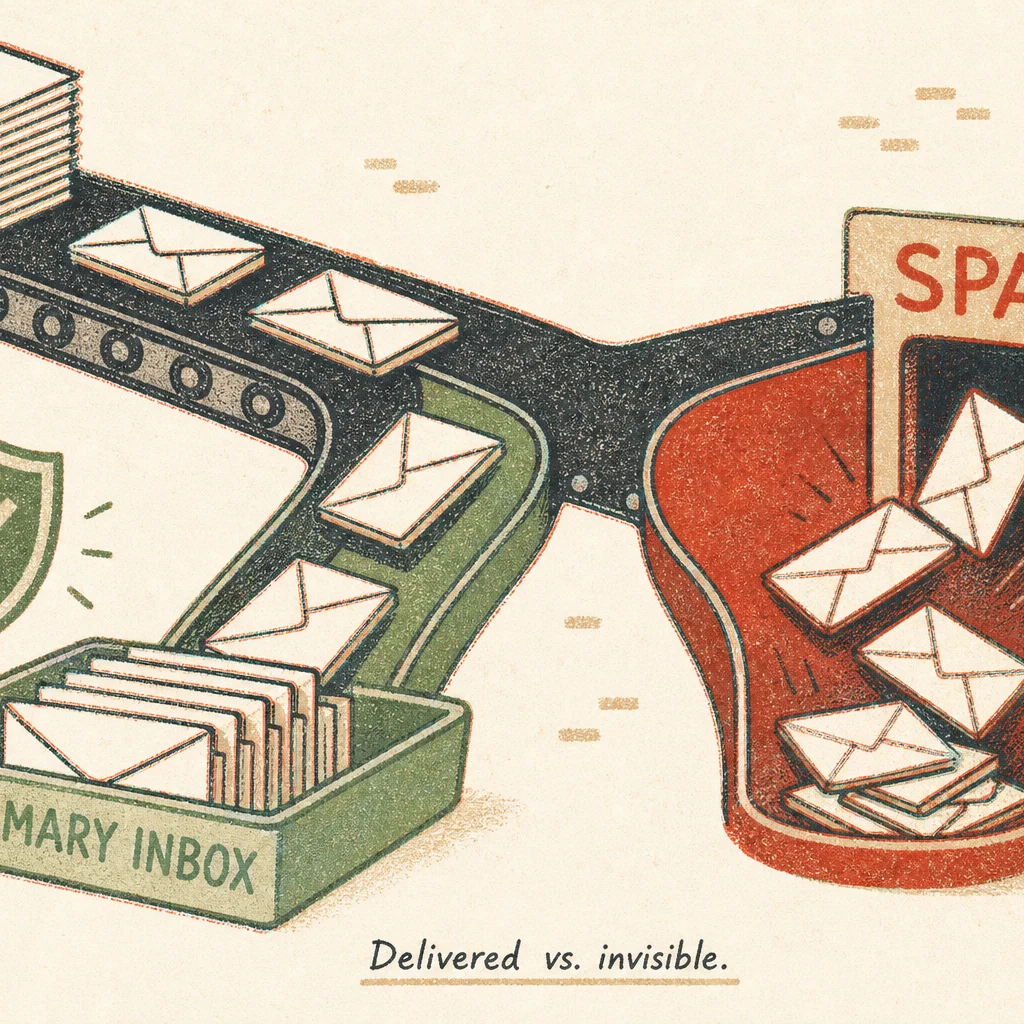
You send 100 emails and hear nothing. The problem is not cold email. It is how you are doing it.
Most cold emails never reach an inbox. The ones that do get deleted before they are opened. Even fewer earn a reply. Fix the infrastructure, the subject line, and the message, and the math starts working.
Why aren’t my cold emails getting replies in 2026?
Your emails are invisible
In 2026, only about 30% to 40% of cold emails land in the primary inbox when senders skip proper setup. The rest go to spam or promotions. If you send from your main domain without authentication and warmup, that number can drop below 10%. You can send 100 emails and only 10 might be seen. No replies does not mean cold email is dead. It means most of your emails were never delivered.
Google and Yahoo bulk sender requirements now enforce strict authentication, complaint-rate, and list-hygiene checks for high-volume senders. Missing SPF, DKIM, or DMARC is an instant trust problem. No warmup means your domain reputation starts near zero. Instantly.ai’s 2026 deliverability benchmarks show domains warmed for about 30 days often reach 90%+ inbox placement. Without warmup, you are sending blind.
The first thing they see feels generic
Average open rates for cold email in 2026 sit around 22% to 26% for typical B2B campaigns. Subject lines that mention a competitor or a specific pain point often jump to 40% or higher. The first few words inside the email matter just as much. If they do not feel relevant, the email is gone in seconds.
Hunter.io’s 2026 subject-line research tested dozens of patterns. The winners used personalization: names, company details, or recent news. A subject line like “[Competitor] just automated this” outperforms “AI solutions for [Company]” almost every time. Research the prospect, then make the first thing they see feel written for one person.
You’re asking for too much, too soon
Most cold emails try to close the sale in the first message. “We build AI automation. Want a call?” That is a trust ask from a stranger. It gets ignored. The goal is not to sell the service on email one. It is to sell the meeting, or even smaller: a reply.
Clay’s 2026 B2B outreach research shows curiosity-led asks convert better than hard closes. “Mind if I send a 2-minute video?” gets more replies than “Let’s schedule a 30-minute call.” The first asks for curiosity. The second asks for commitment. Start small. The rest follows.
What happens when cold emails land in spam instead of inboxes?
Most cold emails never reach the inbox. In 2026, only about 30% of unauthenticated cold sends land where they are meant to be seen. The rest disappear into spam folders or get blocked entirely. If you send 100 emails, 70 might as well not exist. No opens, no replies, no chance to connect. The problem is often not your message. It is the infrastructure behind it.
How many cold emails reach the inbox vs. spam in 2026?
Industry benchmarks in 2026 show that without proper setup, only 20% to 40% of cold emails reach the primary inbox (Clay). The rest are filtered into spam, promotions, or silently discarded. To hit the 90%+ deliverability mark, you need authentication, warmup, and a separate outreach domain (Instantly.ai).
If you send from your main domain without these safeguards, you gamble with sender reputation. Every spam placement trains providers to distrust future sends.
Top 3 reasons Google flags cold email in 2026
- Missing authentication. No SPF, DKIM, or DMARC tells providers your mail could be spoofed (Salesforge.ai).
- High complaint rates. Even a 0.3% spam complaint rate can tank deliverability; many teams aim below 0.1% (Instantly.ai).
- Poor list hygiene. Sending to unverified or outdated addresses triggers filters (Apollo).
How domain warmup improves inbox placement
A new domain starts with zero reputation. Warmup tools simulate real email activity: sends to a private network of inboxes, opens, and replies. That builds trust with Gmail and Outlook.
Apollo’s 2026 guidance still points to 4 to 6 weeks of warmup for a 50% to 70% lift in inbox placement on new domains. Instantly.ai’s 2026 benchmarks report warmed domains consistently near 90%+ deliverability, while unwarmed domains often struggle to break 50%.
Set up a separate domain, authenticate it, and warm it before real campaigns. Otherwise you are shouting into a void.
How do I set up a separate outreach domain to avoid spam filters?
Buy a fresh domain that looks like your brand. Set up SPF, DKIM, and DMARC. Warm it for 4 to 6 weeks before sending real campaigns. That keeps your main domain safe and your emails out of spam.
Step-by-step: authenticate a new cold email domain
- Register the domain. Mirror your brand without copying it exactly. If your company is
acme.com, tryacmehq.comoracme-mail.com. Avoid numbers and hyphens when you can. Use a reputable registrar (Namecheap, Cloudflare, or your current DNS host). - Set up DNS records. Add SPF, DKIM, and DMARC so mail servers know you own the domain and authorize your sending tool.
- SPF: lists servers allowed to send for your domain. Example:
v=spf1 include:_spf.google.com ~all - DKIM: adds a signature. Generate a key in Google Workspace or Microsoft 365, then publish the public key as a TXT record.
- DMARC: tells providers what to do if SPF or DKIM fail. Start monitoring:
v=DMARC1; p=none; rua=mailto:[email protected]
- SPF: lists servers allowed to send for your domain. Example:
- Verify the records. Use MXToolbox or Salesforge.ai’s spam checker before you send.
- Connect a professional inbox. Example:
[email protected]on Google Workspace or Microsoft 365. Free consumer inboxes are a poor fit for scaled cold outreach. - Enable one-click unsubscribe. Google and Yahoo require easy unsubscribe for bulk promotional mail. Most outreach tools add this automatically; if yours does not, add a clear footer link.
How long does warmup take to reach 90%+ deliverability?
Most new domains need 4 to 6 weeks of warmup. Send small batches (start around 10 per day, ramp toward 50 to 100). Use a warmup tool to simulate conversations and build reputation.
Instantly.ai’s 2026 data shows about 30 days of warmup can lift deliverability materially versus skipping the process. Apollo’s 2026 playbooks align: warmed domains toward 90%+ inbox rates, unwarmed domains often stuck near 65%.
Tools that automate warmup and deliverability testing
- Instantly.ai: inbox placement tests plus a warmup network that sends and replies from your domain.
- Salesforge.ai: spam checker for authentication gaps and risky copy.
- Apollo: warmup on select plans, tied to a private inbox network.
Authenticate first. Warm second. Test before you scale.
Why do most cold emails get deleted before they’re opened?
Subject line and first line decide in seconds. If they feel generic, delete wins. In 2026, average open rates hover around 22% to 26%. That means roughly three in four emails never get a real read. The subject line carries most of the open decision. The first line carries the rest.
Average open rate for cold email in 2026
Hunter.io’s 2026 benchmarks put many B2B campaigns in the low twenties for opens. Well-targeted lists often land in the 20% to 30% band. The subject line is the gatekeeper. The first line is the second gate.
Subject lines vs. first-line copy
Subject lines earn the open. First-line copy earns the next sentence. Hunter.io’s breakdown still weights the subject line heavily in the open decision; the opening sentence must feel like a continuation, not a template pivot.
Example: subject “[Company’s competitor] just automated this.” First line: “Saw that [Competitor] cut support time about 40% with a small AI workflow. Here is what they changed first.” That keeps tension from the subject into the body.
Five subject line formulas that still work in 2026
- Competitor mention: “[Competitor] just automated this”
- Question: “Quick question about [specific topic]”
- Curiosity gap: “This saved [Company] 10 hours a week”
- Personalized data: “Your [metric] is 30% below industry average”
- Low-commitment ask: “Mind if I send you a 2-minute video?”
Specific beats generic. Tested patterns in Hunter.io’s 2026 library often lift opens 15% to 30% versus bland industry pitches.
How many follow-ups does it take to get a reply?
Many B2B sequences need about eight touchpoints to book a meeting. One email is rarely enough. Industry research in 2026 still shows replies clustering after several follow-ups, not on the first send.
Clay’s 2026 deliverability and outreach research cites eight touchpoints as a common standard for meeting conversion, with reply rates rising from roughly 1.5% on email one toward double digits by later steps in strong sequences.
Space follow-ups 3 to 5 days apart (Hunter.io’s 2026 cadence guidance). Too tight feels pushy. Too loose, they forget you.
Example cadence:
- Day 1: first email
- Day 5: follow-up 1
- Day 9: follow-up 2
- Day 14: follow-up 3
- Day 19: follow-up 4
- Day 24: follow-up 5
- Day 29: follow-up 6
- Day 34: follow-up 7
Each touch should add something: a new insight, a short video, a case study. Never only “checking in.”
What’s the biggest mistake in cold email copy?
Most cold emails ask for the sale too soon. They pitch the service before the prospect knows who you are. The first email should earn a reply, a click, or a small yes, not a contract.
Why most cold emails fail to sell the meeting
Opens with “We do X, want a demo?” get ignored. Clay’s framework still holds in 2026: sell the meeting (or the next micro-step), not the full service, on email one.
Hunter.io’s 2026 tests show curiosity-led copy (questions, competitor hooks, quick insights) often earns several times more replies than credential-heavy pitches.
How assumptions kill reply rates
I get cold emails every day. Many assume a problem I do not have. They pitch scaling AI when the business is already scaled. That signals zero research.
Clay’s 2026 case comparisons still show researched emails far above generic blasts (on the order of 12% vs. low single digits for spray-and-pray). Persona-based outreach continues to outperform one template for everyone.
The 2-minute video trick
A short screen recording beats a long wall of text. Clay recommends about two minutes showing how a similar business solved one problem. Apollo’s 2026 engagement stats still show video links earning far more clicks than text-only bodies when the video is specific, not polished for polish’s sake.
How do I research prospects before sending cold emails?
Research turns strangers into conversations. Skip it and you sound like a blast. Do it well and you earn the right to a reply.
Data points that prove you did homework
Three layers: company, role, recent activity.
- Company: industry, size, stack, competitors, funding. Clay-style enrichment can surface parent-child accounts for enterprise branches.
- Role: title, team size, reporting line, typical pains. A VP of Operations at a 500-person SaaS company cares about different levers than a solo founder.
- Recent activity: hires, launches, earnings themes, LinkedIn posts, open roles. Hunter.io’s 2026 personalization notes: one specific detail lifts opens; two relevant details push further.
If you cannot find data, do not guess. “I noticed you are hiring for RevOps” beats “I assume churn is your biggest problem.”
Tools that automate research
- Clay: company signals (stack, funding, hiring, news) in one workflow.
- Apollo: titles, direct dials, LinkedIn URLs, verification flags.
- Hunter.io: email verification before send.
Instantly.ai’s 2026 benchmarks tie verified lists to meaningfully higher reply rates than unverified dumps. Goal: about 90 seconds per lead, not an hour.
How much time per prospect?
Aim for 60 to 90 seconds. Under 60 seconds, replies often stall near low single digits. Between 60 and 90 seconds, many teams report reply rates around 7% in 2026 benchmarks. Past 90 seconds, returns usually flatten. Batch with a timer: one company fact, one role fact, one recent signal. If nothing appears in 90 seconds, skip or nurture later.
What’s the next step after fixing my cold email strategy?
You fixed infrastructure, copy, and sequence. Now test before you scale. One metric tells you if it is working: replies.
Test deliverability before scaling
Start with 20 to 50 emails to real prospects. Use inbox placement tests, not opens alone. Salesforge.ai’s spam checker simulates Gmail filters. Instantly.ai shows primary vs. promotions vs. spam. If more than 10% land in spam, pause and fix auth or warmup.
Templates for high-converting sequences
Borrow structure from Clay’s GTM playbooks and Hunter.io’s subject-line library. Swap in their competitor, metric, and problem language. A/B one variable at a time: subject, first line, or CTA.
The one metric to track
Reply rate per sequence. Apollo’s 2026 benchmarks still cite 3% to 5% as a healthy range for good sequences. Below 2%, debug subject, first line, or ask. Sequences with five or more value-added follow-ups often beat single-email blasts by a wide margin.
FAQ
Why aren’t my cold emails getting replies in 2026?
Usually deliverability, weak subject lines, or asking for too much on email one. Fix SPF, DKIM, DMARC, warmup, and a separate domain first. Then personalize the subject and first line and ask for a small next step.
How many cold emails reach the inbox in 2026?
Without proper setup, about 20% to 40% hit the primary inbox. With authentication, warmup, and a dedicated sending domain, many teams reach 90%+ inbox placement.
What are Google’s top spam triggers for cold email in 2026?
Missing SPF, DKIM, or DMARC; complaint rates above roughly 0.3%; and poor list hygiene (unverified or stale addresses).
How long should domain warmup take in 2026?
Plan 4 to 6 weeks for new domains, ramping volume slowly with a warmup tool, before full campaigns.
What is a good cold email open rate in 2026?
Many B2B campaigns land around 22% to 26%. Strong personalization on subject and first line can push toward 40% on targeted lists.
How many follow-ups should I send?
About eight touchpoints over several weeks is a common 2026 benchmark for B2B meeting conversion, with 3 to 5 days between emails and new value each time.
Should I pitch my service in the first cold email?
No. Earn curiosity and a micro-yes first (reply, short video, quick question). Sell the meeting before you sell the full offer.
How much research per prospect in 2026?
About 60 to 90 seconds: one company detail, one role detail, one recent signal. Skip leads where you cannot find anything specific in that window.
What metric matters most for cold email success?
Reply rate per sequence. Aim for 3% to 5% on a warmed, verified list; debug copy and deliverability if you are below 2%.
Thank you for reading. I hope to see you inside of my community. xx Katrin