
If you run a small or micro business, especially one built around community, a membership, or repeat clients, you have probably felt this: the AI draft is “fine,” but it does not sound like the person your members hired. In 2026, that gap matters twice: humans notice it instantly, and patterns of generic, interchangeable writing are easier for both search systems and AI answer engines to treat as low-value noise.
The problem is what happens when you use AI without your stories, your guardrails, and the specific language your community uses when they ask for help. Generic AI strips all three out at once.
Whether you are a wellness practitioner (coach, educator, aromatherapist, herbalist, bodyworker) or a course creator and membership owner, the fix is the same in principle: keep expertise and voice in the loop. At AI Grimm, that is what we focus on: workflows where your briefs and documents shape the draft, not just whatever the model guesses from the open web.
Below is a system that fits solo operators and tiny teams: usable for blogs, member updates, lesson scripts, email, and sales pages, while still supporting traditional SEO, voice-style answers (AEO), and AI summaries (GEO).
The problem: why generic AI content quietly erodes memberships and sales
There are seven ways it tends to go wrong for membership owners and micro businesses specifically:
- 1It sounds like “every brand,” not like your corner of the internet. For communities, that is lethal: members stay for identity and trust.
- 2It erases nuance you normally protect (scope of practice, who the offer is not for, safety framing in wellness contexts).
- 3It uses slogan vocabulary instead of member vocabulary, so your FAQs, onboarding, and emails feel like a stranger wrote them.
- 4It can overclaim when not anchored to your sources, which is risky in education and wellness-adjacent topics.
- 5It weakens conversion paths for small teams: you do not have a giant ads budget to compensate for fluff.
- 6It makes content ops fragile: when everything sounds the same, you cannot reuse assets cleanly across cohorts, tiers, or seasonal pushes.
- 7It lowers “quotability.” Answer engines and AI summaries favor content with clear definitions, crisp lists, and stable facts. Hollow text does not get referenced.
A practical workflow: built for community and membership calendars
Step 1: mini-brief (about five minutes, in your voice)
Answer:
- Member segment: Who is this for this week (beginners, alumni, a specific track)?
- Job-to-be-done: What will they be able to do after consuming this?
- Your stance: What do you believe that a generic blog would get wrong?
Step 2: drop in “voice anchors”
Paste phrases you have actually said in community posts, calls, or DMs. Require those anchors to survive every revision.
Step 3: draft with boundaries
When you write the prompt, ask it to follow the brief and keep your anchors intact. Tell it to flag anything it cannot support from your sources. And ask for two hook options plus an outline before it writes anything resembling a final draft.
Step 4: source-grounded drafting (RAG-style, without needing to be technical)
Collect snippets from member FAQ threads (anonymized if needed), onboarding docs, checklists, lesson notes, and PDFs you are allowed to reuse. Paste excerpts and ask for expansions only grounded in that text. That is how “pull from my files first, then draft” becomes everyday practice, and it is central to how we think about dependable business content at aigrimm.com.
Step 5: membership-aware edit pass
Read aloud. Cut template tone. Add one “community touch”: a norm you reinforce, a milestone members recognize, or a seasonal rhythm (renewals, challenges, live calls).
Step 6: proof
One screenshot, one short story, one measurable outcome, or one reputable citation, especially when the topic touches health, safety, money, or results.
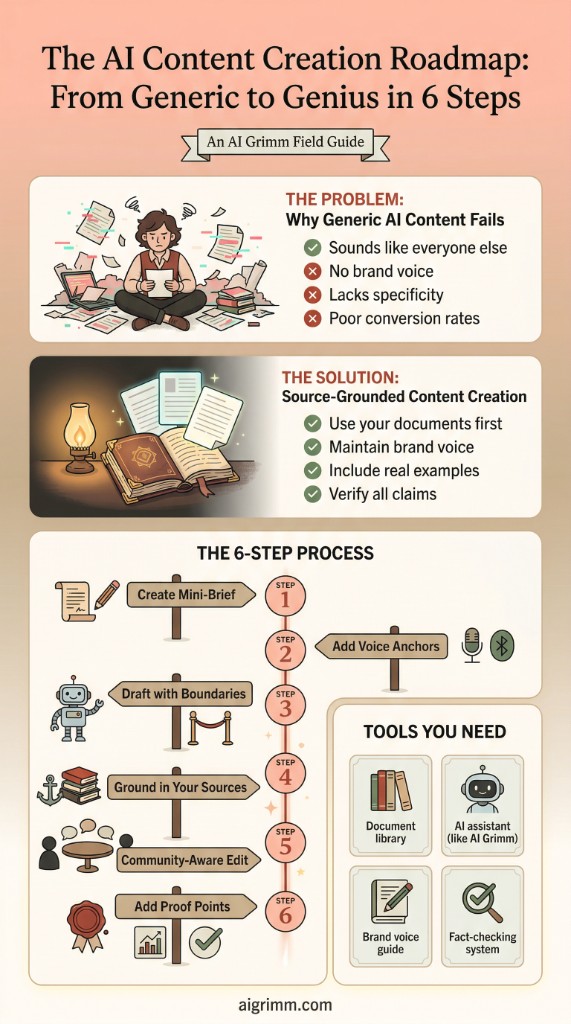
What small teams need in the stack (keep it minimal)
- Capture: where questions show up (community, inbox, consult notes).
- Library: repeatable assets (SOPs, curricula, pricing rationale, welcome sequences).
- Assembler: a consistent place where brief + library + outline meet.
- Publish checklist so you are not relying on memory during a busy launch week.
Mistakes that hurt micro businesses and membership owners
- Publishing first drafts because they look “professional.” Members sense mismatch fast.
- One prompt for everything instead of templates per content type (welcome, weekly digest, lesson intro, sales).
- No FAQ layer on key pages. FAQs map to real questions your community already asks (great for AEO).
- Confusing activity for retention: more posts ≠ more belonging; clarity and relevance do.
- Letting AI invent details about protocols, pricing, guarantees, or sensitive wording. Verify every time.
SEO, AEO, and GEO in plain English (2026)
- SEO: one clear intent per page; helpful depth; internal links to related member resources.
- AEO: direct answer up top; headings written like real questions (including how people talk, not only keywords).
- GEO: define concepts simply (for example, RAG as “draft from your documents first”); use scannable structure so summaries quote you accurately.
Conclusion
When AI content replaces the things only you can provide - your norms, your proof, your actual voice - memberships notice. It does not take long. The goal is not slower content. It is a system where AI handles the drafting and you keep the strategy, the sourcing, and the last human pass.
If you want your content to stay grounded in your actual business rather than the generic web average, start with AI Grimm. For peer implementation and real briefs in the open, the Indie AI Business Hub is another place we gather; the product home for what we build remains aigrimm.com.
FAQ
Why does generic AI content hurt memberships and communities most?
People stay for identity and trust. When posts sound like “every brand,” they stop matching how you actually coach, teach, or moderate. Members feel the drift fast.
What is RAG in simple terms?
Retrieval-augmented generation: pull relevant snippets from your briefs and files first, then draft in that context. It is how you keep community vocabulary and guardrails in the loop.
Will AI-assisted content hurt my SEO if I publish often?
Thin or repetitive pages can struggle. Useful, specific, experience-backed posts still match what search systems reward, whether AI helped draft or not.
How should micro businesses tune for voice-style answers (AEO)?
Write headings like real questions people ask aloud, answer in one or two plain sentences up top, then expand with structure members can scan.
How long should a pillar post be in 2026?
Long enough to satisfy intent, not a word-count trophy. On competitive topics, thorough coverage often lands around 1,800–3,000 words when every section earns its space.
Do I need citations for GEO and AI summaries of my pages?
For factual claims, yes. Clear sourcing helps humans trust you and reduces wrong compression when models quote or summarize you.
What is the smallest habit that fixes “generic” the fastest?
A five-minute mini-brief before every draft: who this is for, the job-to-be-done, and one stance a generic blog would get wrong, then a human pass for specificity before publish.
Thank you for reading. There is plenty more on the blog whenever you are ready. And if you want to build alongside others, come and join us inside the community.