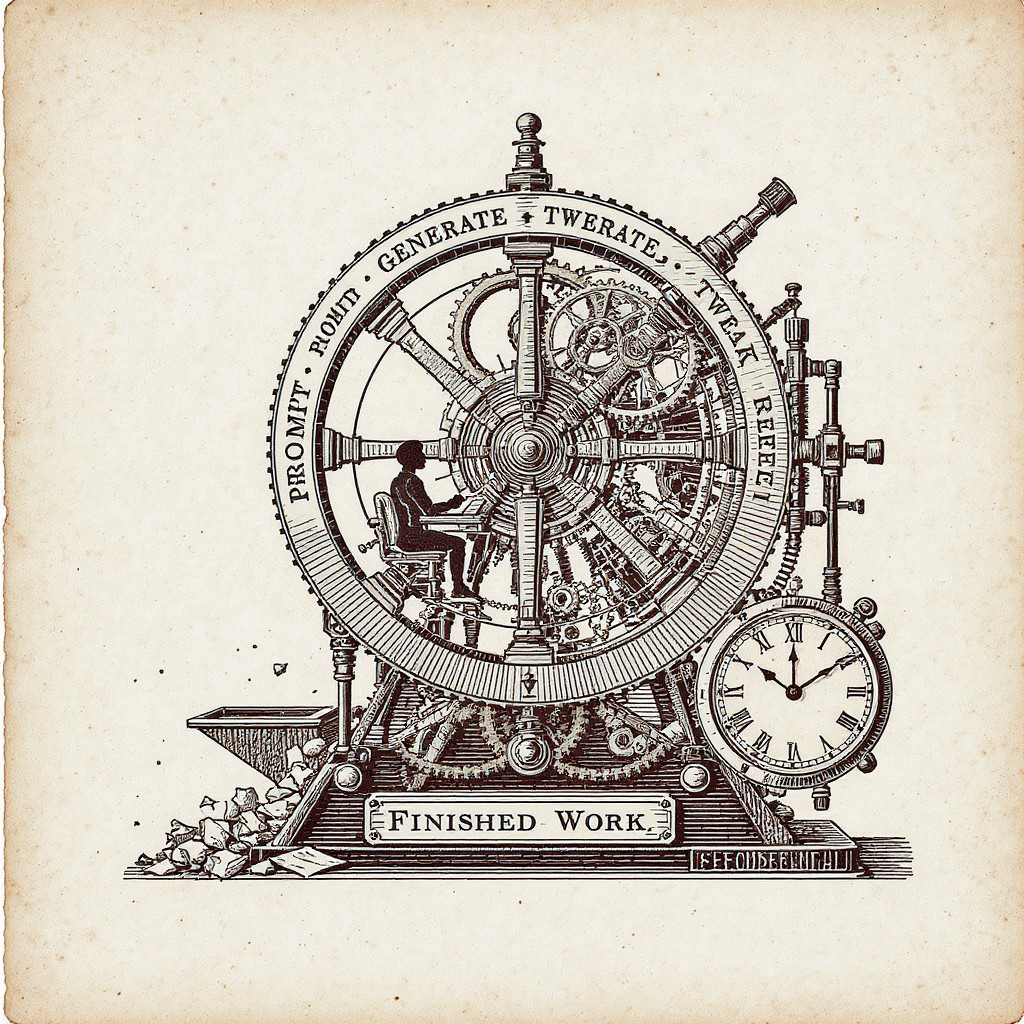
You know what a productive session feels like. You generated twelve variations. You refined the hook six different ways. You tried a completely different angle. You spent three hours on it.
At the end, you had a folder full of outputs and nothing shipped.
That is the illusion of productivity in infinite iteration. It feels like work. It registers as effort. Your brain counts the time spent and marks it as progress. But if nothing finished and nothing shipped, the morning's work was a loop, not a step forward.
This is one of the more quietly expensive patterns in AI-assisted creative work. And it is especially common because AI makes iteration so easy that the cost of one more round feels like zero.
Why the loop forms
The first time you run a prompt and get something back, you compare it to your mental image of what you wanted. If it does not match, you tweak and regenerate. That is the right instinct. The problem is that the mental image is often not defined clearly enough to ever be matched.
When you do not know exactly what you are looking for, you know when something is not quite right. You do not know when something is done.
So you keep going. The AI is patient. It never says "I think what you have is fine." It generates whatever you ask for, every time, without feedback on whether you are moving toward something better or just moving.
There is always the possibility that the next generation will be the one. It is close enough to be plausible. So you try again. Three hours later, you are no closer to done than you were after the second iteration.
The moment the loop becomes the problem
One iteration is refinement. Two or three is normal. Beyond that, you are usually dealing with one of two things: a brief that was not clear enough, or a standard that was not defined.
If your brief was not clear, more iterations will not fix it. The AI is generating variations on a vague target. You will keep getting variations, none of which feel exactly right, because "exactly right" was never specified.
If your standard was not defined, you do not have a finish line. "Better" is not a finish line. "My best version" is not a finish line. "Includes these three specific things and is under 300 words" is a finish line.
The loop does not close without a finish line.
What getting out of the loop looks like
Define done before you start
Not vaguely. Specifically. "This email is done when it has a hook that mentions the specific client situation, a single clear CTA, and runs under 200 words." Write that down. When the output meets those criteria, you are done. Not when it feels perfect.
Set a generation limit before you start
Two or three rounds, maximum. If you are not at done after three rounds, stop and look at the brief, not at the output. The problem is usually upstream.
Separate the generate phase from the edit phase
Generate once or twice. Then close the AI tool and edit in a plain text document. The edit pass is where you make it yours. It is also where you stop generating and start deciding.
Recognize the difference between a draft and a direction
A draft is something you finish. A direction is something you keep adjusting. If you are still in the direction phase after thirty minutes, you are not ready to generate yet.
The cost of the loop that nobody counts
The obvious cost is time. Three hours that produced nothing shipped is three hours gone.
The less obvious cost is decision fatigue. Every iteration requires a judgment: is this better than the last one? After ten rounds, your ability to make that judgment degrades. You are comparing outputs that are all variations of the same thing, none of them obviously better, and your brain is tired.
The least obvious cost is the confidence hit. When you spend three hours on something and do not finish it, there is a low-grade sense of having failed, even if you tell yourself you were "working on it." That accumulates. It makes the next session harder to start.
One finished draft, even if it is not perfect, does more for your momentum than ten highly-iterated ones that never shipped.
FAQ
How many AI iterations is too many?
More than three rounds on the same piece without a clear improvement is usually a signal that the brief needs work, not the output.
How do I know if I am in the productivity illusion loop?
If you have been working for an hour and nothing is ready to ship or share, check whether you have a finish line defined. If you do not, that is the problem.
What does a good finish line look like?
Specific and verifiable. "Contains X, runs under Y words, addresses Z audience" is a finish line. "Feels right" is not.
Why does AI make this worse than doing it manually?
Because the cost of one more iteration is almost zero. Manual work has natural stopping points. AI generation removes them, so the loop can continue indefinitely without the friction that would otherwise make you stop.
Can I use AI to help define the brief?
Yes. Describing what you are trying to create to the AI before asking it to generate often surfaces the gaps in your thinking. Use the first round for brief-building, not output-building.
Thank you for reading. There is more on the blog whenever you are ready. And if you want to work through this alongside other coaches and creators, come and join us inside the community.