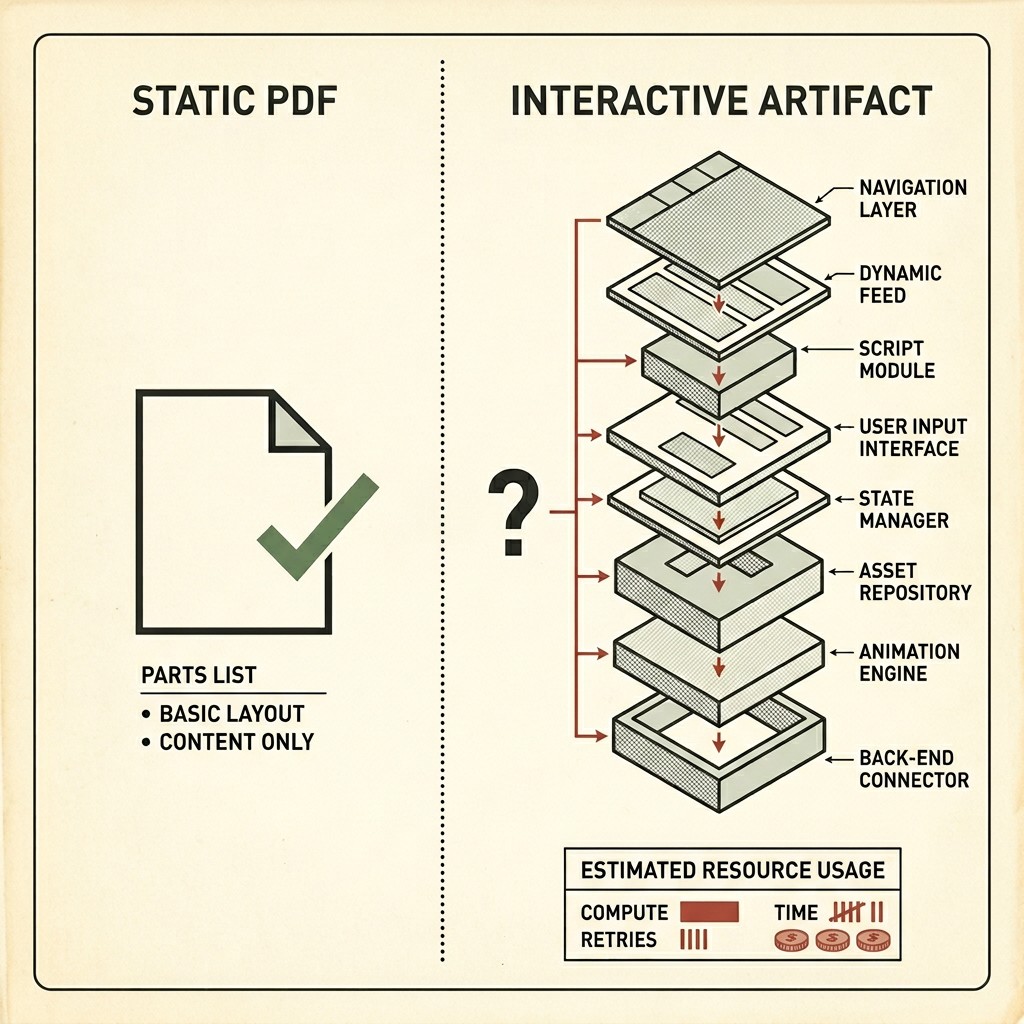
A PDF is cheap to make. Always has been. You write the content, you drop it into a template, you export. Twenty minutes if you have the words ready. An hour if you are starting from scratch.
An interactive artifact is not cheap. It just looks cheap because the interface that produces it is simple.
This is one of the more expensive misunderstandings in the current AI wave. Coaches and course creators are generating interactive tools, dynamic calculators, responsive quizzes, and multi-step lead magnets and treating them like they are producing PDFs with extra steps. They are not. And the gap between those two things has real costs.
What the difference actually is
A static PDF is a document. It holds information. It does not respond, adapt, or require anything from the infrastructure that hosts it beyond storage.
An interactive artifact is a piece of software. Even if it looks like a simple quiz or a calculator, it has logic behind it. It runs queries. It stores or processes inputs. It renders differently based on what the user does. Every time someone interacts with it, that interaction requires compute.
Multiply that by thousands of users, dozens of revisions, retries when the AI generation does not work the first time, and the cost stack becomes real. Not ruinous for every project, but real, and often invisible to the person building it.
The hidden cost stack
When you build an interactive artifact with an AI tool, the cost includes:
Compute for generation
Every prompt, every regeneration, every revision runs on infrastructure. The more complex the artifact, the more compute each iteration uses.
Retries
AI-generated interactive tools rarely work perfectly on the first pass. You prompt, you test, you find a bug, you prompt again. Each retry is another generation. On a complex artifact, that can be ten or fifteen rounds before something is stable.
Hosting
A static PDF lives in a storage bucket. An interactive artifact lives on a server that runs continuously. That is a different cost model and a different maintenance burden.
Attention cost
Interactive artifacts require more from your audience too. They have to engage with it rather than just read it. The artifact needs to work reliably or you lose them at the point of highest engagement.
Maintenance
A PDF from 2022 still works in 2026. An interactive artifact can break when the underlying platform changes an API, updates pricing, or deprecates a feature.
When interactive is worth it
None of this means you should not build interactive artifacts. It means you should build them when the interaction is the point.
- A quiz that gives the user a personalised result: worth it. The result is the value, and a PDF cannot deliver it.
- A calculator that saves your client thirty minutes of manual work: worth it. The calculation is the value.
- A multi-step intake form that routes clients to different resources: worth it. The routing logic is the value.
- A PDF with a button that just links somewhere else: not worth the overhead. That is a PDF with a pretend interactive layer, and it carries the costs without the benefits.
When a PDF is the right answer
Most of the time. A well-structured PDF that is specific, readable, and grounded in your actual expertise outperforms a poorly-built interactive artifact in almost every practical metric.
It loads reliably. It can be downloaded, saved, and referenced offline. It costs nothing to host once it exists. It does not break. And it delivers its value in a format your audience already knows how to use.
The assumption that interactive is inherently better is a 2024 idea that the market is quietly correcting. Audiences are not rating their lead magnets on interactivity. They are rating them on whether they delivered the promised outcome.
The practical question to ask before you build
Not "should this be interactive?" but "does the interaction change the value the person gets?"
If yes, build the interactive version. The cost is justified. If no, build the PDF. Do it well. Make it specific. Ship it faster and spend the saved time on the thing that actually moves your business.
This is one of the framing questions built into how AI Grimm approaches content work: start with what the person needs to get from the thing, not what format looks most impressive.
FAQ
What is an interactive artifact?
Any AI-generated output that responds to user input: a quiz, a calculator, a multi-step tool, a dynamic recommendation engine. Distinct from a static document by having logic and user interaction.
Why does interactivity cost more?
It requires compute to generate, retries to get right, ongoing hosting to run, and maintenance when platforms change. Static documents have none of those ongoing costs.
Should I stop using interactive lead magnets?
No. Use them when the interaction is the core of the value. Avoid them when they are just a way to make a PDF look more impressive.
How do I know if my interactive artifact is worth the cost?
Ask whether the user gets something from the interaction they could not get from a document. If the answer is yes, it is worth it. If the answer is "it looks better," probably not.
What makes a PDF effective in 2026?
Specificity, a clear outcome, and content grounded in real expertise. Format is not the issue. Vague, generic content in an interactive wrapper still does not convert.
Thank you for reading. There is more on the blog whenever you are ready. And if you want to work through this alongside other coaches and creators, come and join us inside the community.