
If you run a small business, you probably have a folder that embarrasses you a little. Not because it is messy. Because it is full of truth nobody sees except you and your clients.
Onboarding notes. Welcome sequences you tweaked for months. The PDF that finally explains your method without you having to repeat yourself. The email you wrote at 11 p.m. that said what you actually believe.
That is not clutter. It is the spine of your brand.
We baked retrieval augmented generation into AI Grimm for a simple reason we kept seeing in the wild: people were using AI like a talented stranger who had never read their business. The stranger writes smooth sentences. The sentences just were not grounded in what you already decided, already teach, and already promised.
So here is the plain English version of RAG, and why it matters for marketing, and why it belongs in the product on purpose, not as a buzzword sticker.
Why the "blank box" breaks first
When time is short, most of us market from memory.
Memory is kind. It also flattens. It turns your sharp, odd, specific work into "helpful tips for everyone," which is exactly how content starts to sound interchangeable.
You lose the questions your members actually ask. You lose the sentences you already wrote in reply. You lose the little warnings you give because you care. You lose proof you forgot you saved: a timeline, a template, a before and after you are allowed to share.
We built grounding into AI Grimm because generic drafting was never the real enemy. Ungrounded drafting was. A blank prompt invites the model to improvise your expertise. Your business deserves a better starting place.
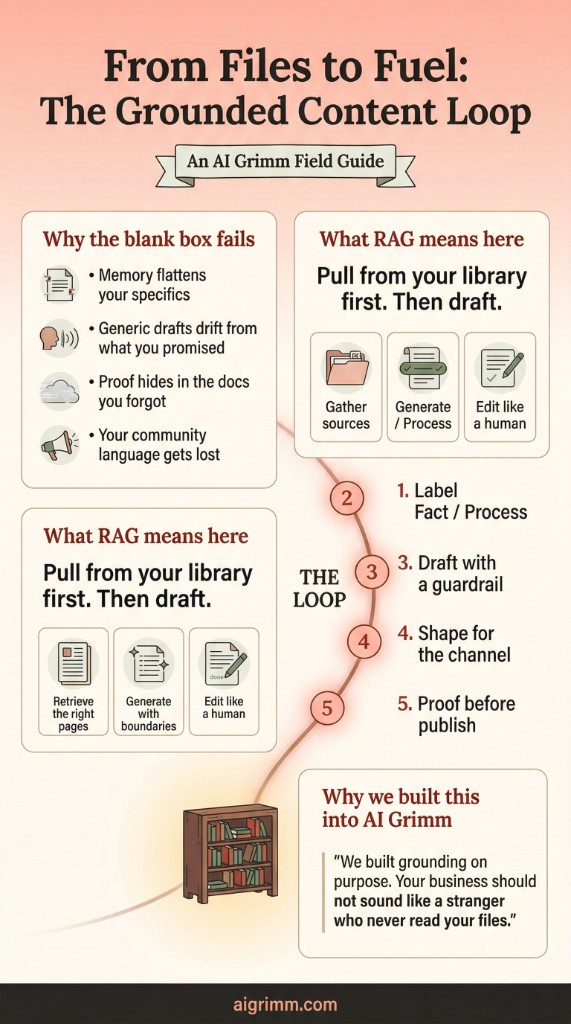
What RAG is, without the conference talk
Think of it as librarian energy plus writer energy:
- First, you retrieve. You go get the right chunks from your stack.
- Then you generate. You expand, rearrange, polish, but you do not pretend the library never existed.
You can do this with copy and paste and good discipline. You can also do it with tooling that searches an approved library so you are not hunting at midnight before a launch.
Either way, the marketing win is the same. The draft stops floating. It starts attached.
The loop that turns documents into marketing
- 1Pick one job before you touch a draft. Examples: explain the method, answer the top three worries, announce the next cohort, publish the weekly member note.
- 2Collect a handful of sources, not the whole drive. Onboarding pages. Scope language. Lesson outlines. FAQ exports from your community. Emails you have sent fifty times because they work.
- 3Label what you have. Is it a fact, a process step, or a voice moment (a metaphor you always return to, a line you say on calls)?
- 4Draft with a rule that sounds boring and saves you. If it is not supported by what you pasted, mark it as needs a source or cut it.
- 5Repurpose on purpose. One grounded spine can become a blog post, a short sequence, a carousel outline, a thread, a pinned FAQ. Same truth, different shape.
- 6Proof before publish. One real example goes further than ten adjectives. If you state something measurable, point to where it lives or soften the claim until it is honest.
This loop is why the product direction matters to us. AI Grimm is not here to help you churn faster for its own sake. It is here to help you carry what you already built into the places new people actually look.
Marketing gold you might be stepping over
- The "who this is for / not for" section you wrote when you were brave.
- Objection replies that already sound like you, because they are you.
- The table of contents of your program. It is a promise map, not a dump.
- House rules and ways to get help. That is culture, which is also content.
- Deliverables and timelines. Boring on paper, clarifying on a sales page.
None of this is a trick. It is operational truth, and truth is easier to trust than a slogan.
What we do not want you to do
- Do not shovel a forty page PDF into a prompt and hope for poetry. Noise makes bad confidence.
- Do not let "draft" bypass review on guarantees, outcomes, health adjacent promises, money claims, or anything legal shaped.
- Do not skip the human pass. Grounding reduces hallucination risk. It does not replace taste.
- Do not keep a library you never update. Stale sources make stale marketing.
- Do not confuse activity with care. Your members can feel filler.
SEO, voice search, and generative summaries (without the alphabet soup taking over)
For classic search, give each page one clear job and link related pages like you would guide a newcomer through your house.
For voice style questions, use headings that sound like real people talking, answer in a sentence or two up top, then go deeper.
For AI summaries, say what you mean plainly, define your terms once, use short lists where they earn their keep, and cite when you state facts. Generous structure helps humans first. Models second.
Why this belongs in AI Grimm, not as an add-on
We kept watching smart operators do the same painful thing. They would generate a month of content and still feel allergic to it. Not because AI was useless, but because it was unmoored.
So we leaned into the part of the work people skip when they are busy: choosing sources, narrowing scope, and making reuse safe. That is the quiet work that makes marketing feel like your business instead of a costume.
If that sounds like the way you already want to work, start from aigrimm.com. The story of the product is the story of this habit. Ground the draft, then let your voice finish the sentence.
FAQ
What is RAG in simple terms?
Retrieval augmented generation: you retrieve the right passages from your own materials first, then generate. The draft is anchored in what you already teach, sell, and promise, not in the model's generic defaults.
Why does "blank box" AI marketing sound interchangeable?
Because the highest-probability phrases win. Without your documents, there is nothing to pull you back toward buyer language, scope language, or proof you already wrote.
How many excerpts should I gather before I draft?
Aim for a handful that match one job (one audience moment). A few strong, labeled chunks beat dumping an entire drive. Narrow scope is what makes retrieval feel like strategy, not chaos.
Can one grounded piece become a blog, email, and thread?
Yes. Same spine, different costume: one verified outline or memo can become multiple surfaces as long as claims stay tied to the same sources.
If the draft used my files, do I still need a human review?
Yes. Grounding cuts hallucination risk; it does not replace taste, compliance, or nuance for health-adjacent topics, money claims, or guarantees.
Is RAG only for technical teams?
No. Copy-paste discipline is RAG in miniature. Software makes the "find the right page" step repeatable so busy operators are not hunting at midnight.
Why does this matter for memberships and client businesses?
Members notice when public language drifts from what you say inside the community. Grounding keeps internal norms, examples, and boundaries consistent in outward content.
Thank you for reading. If something here resonated, come and say hello inside the community.