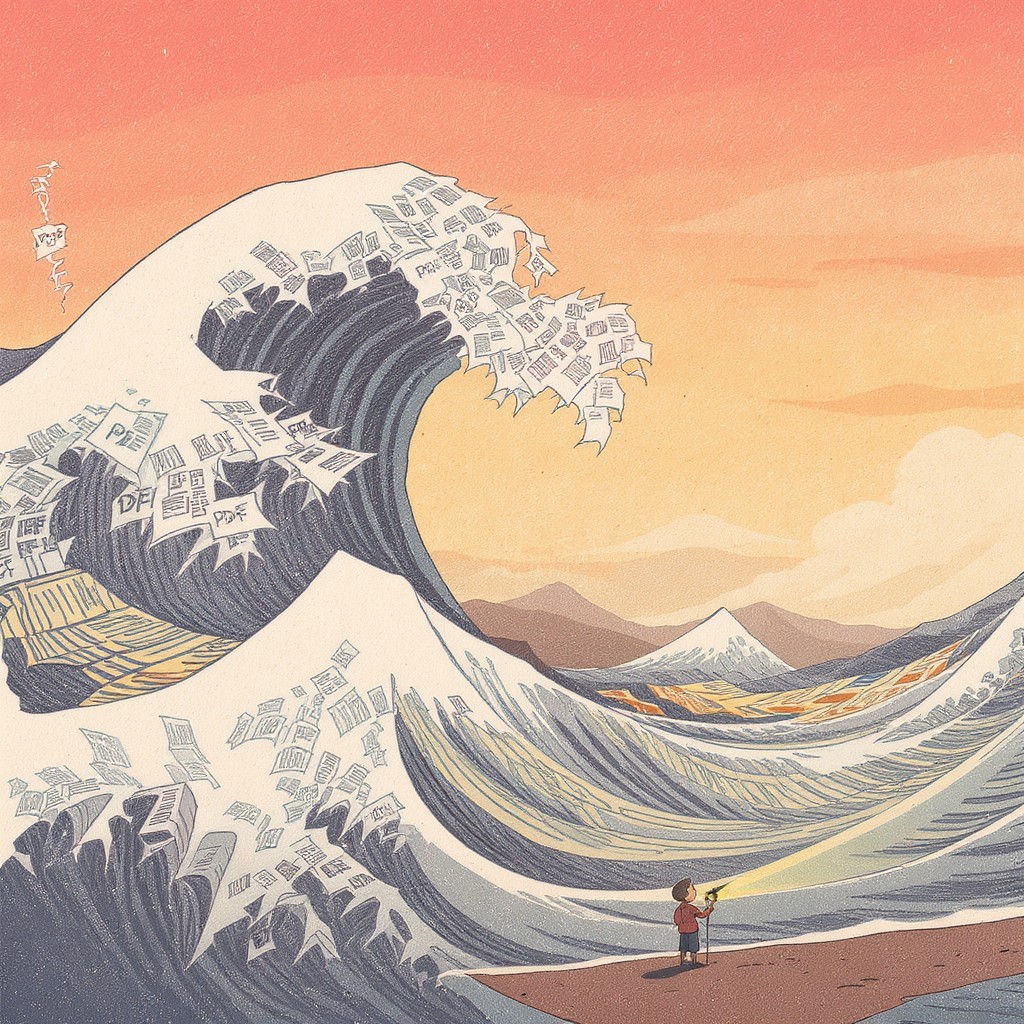
There is no shortage of things to consume right now. Coaches are publishing lead magnets. Course creators are shipping toolkits. Solo founders are generating worksheets, calculators, checklists, and interactive guides at a pace that was impossible two years ago.
The problem is not the output. The problem is the other side of the equation.
Human attention has not scaled with AI production. You still have roughly three seconds to convince someone your thing is worth opening. Your audience still has the same 24 hours. The inbox is still the inbox. And every other coach in your niche has also just discovered they can create a lead magnet in an afternoon.
This is the artifact tsunami. And it is arriving faster than most people building inside it realize.
What an artifact actually is
An artifact, in this context, is anything AI helped you produce and package: a PDF guide, an interactive tool, a template, a mini-course, a quiz, a worksheet. The term covers everything from a one-page checklist to a full resource hub.
The defining feature is that they are easy to create now. Genuinely, actually easy. What used to take a designer and a copywriter and two weeks now takes an afternoon and a decent prompt.
That is good news for creators. It is also the source of the problem.
When everyone has an artifact, none of them stand out
Three years ago, a well-designed lead magnet gave you a real edge. Most competitors were not doing it well, or at all. If you had a clean PDF with clear value, you converted.
Now your ideal client opens their email and sees four lead magnets before lunch. They have been burned by "free guides" that were 12 pages of padding with one useful idea buried on page nine. They have downloaded calculators that did not work properly on mobile. They have given their email address to three people this month in exchange for something that sat unread in their downloads folder.
They are not less interested in learning. They are just less willing to bet their attention on something that might not be worth it.
The creators who cut through are doing one thing differently
They are not making more artifacts. They are making clearer ones.
Clearer promise
One specific outcome, named plainly on the cover, in the subject line, in the first sentence. Not "the ultimate guide to content strategy" but "how I write a month of posts in one sitting."
Clearer format
The length and format match the promise. If the outcome takes three steps to explain, it is three pages, not thirty.
Clearer fit
The artifact is built for one person with one specific problem, not a broad audience with vague aspirations. The more specific the audience, the faster the right person recognizes themselves in it.
This is not a design problem or a copywriting problem. It is a clarity problem. And AI does not automatically solve it. AI accelerates production. Clarity still comes from you.
What the tsunami means for your AI Grimm workflow
The tools matter less than the brief. An artifact built from a vague prompt and no audience definition will look polished and perform poorly. An artifact built from a clear brief, grounded in your actual materials, built for a specific person, will outperform it every time.
When you use AI Grimm to build content, the voice guardrails and document grounding are there precisely for this reason. Not to make your output sound more like you for its own sake, but because specificity and voice are the two things that cut through a noisy feed. Generic content, however well-formatted, disappears.
The tsunami is real. The answer is not to produce less. It is to produce with more intention about who the artifact is for and what one thing it needs to do for them.
FAQ
What is an AI artifact?
Any output AI helped produce and package for distribution: guides, tools, templates, worksheets, calculators, mini-courses. The term covers the full range of content products that have become cheap to create.
Why is attention still limited if AI is making creation easier?
AI changes the supply side. It does not change how many hours are in a day or how many emails a person can read before their brain stops processing. The ratio of content to available attention has shifted dramatically in favor of content.
How do I make my artifact stand out when everyone has one?
Narrow the audience and sharpen the promise. "A guide for coaches" disappears. "How nutrition coaches can write a client welcome sequence in one afternoon" finds the right person fast.
Does AI content hurt lead magnet performance?
Not inherently. Thin, generic, obvious AI content does. Specific, grounded, voice-driven content performs well regardless of how it was produced.
How long should a lead magnet be in 2026?
Long enough to deliver the promise, short enough to finish in one sitting. Most effective lead magnets right now are under 1,500 words or under 10 minutes to consume. Longer is not better. More specific is better.
Thank you for reading. There is more on the blog whenever you are ready. And if you want to work through this alongside other coaches and creators, come and join us inside the community.