
You solve problems every day. You do it in client calls, in workshops, in the quiet moments when someone finally understands what you have been trying to say. Then a stranger asks a simple question at a party, or a prospect asks it on Zoom: "What is your method?"
And the expert brain does something humiliating. It goes blank, or it overexplains, or it shrugs out a sentence that undersells a decade of practice.
You are not missing brilliance. You are missing packaging.
Expertise that cannot be named, sequenced, and taught will always feel smaller than it is. The market buys clarity. Your clients buy confidence. Both require a spine.
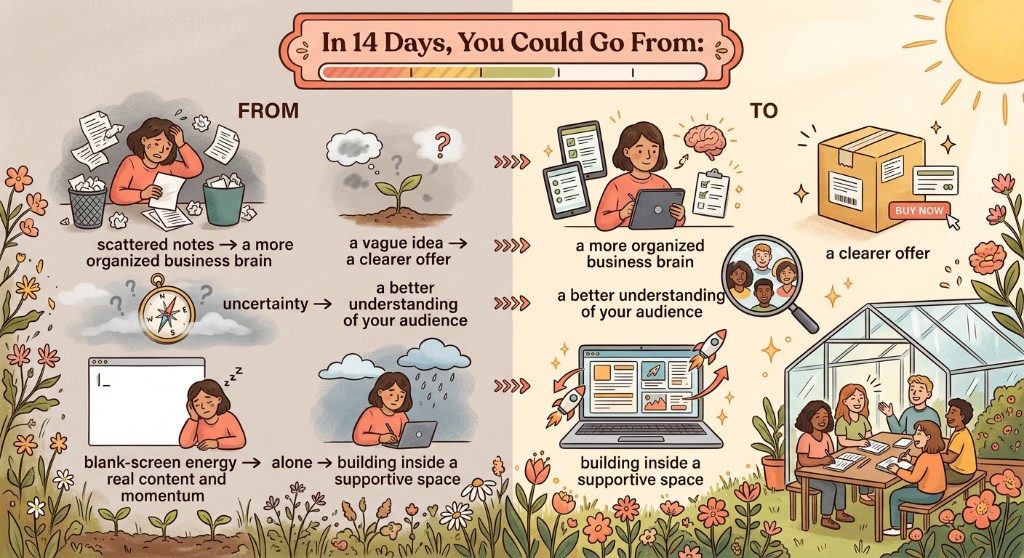
This article is about that spine: the framework method, and how we move people from scattered knowledge to a documented method inside the fourteen day experience we run with AI Grimm. Many participants call it Spring De-Dust. The full program name on paper is the Business Alignment and Un-Dusting Challenge. Same journey. Same goal. Turn what you already know into something you can sell without feeling like you are performing a personality you do not recognize.
Open the 14-day challenge in the AI Grimm Society classroom on Skool →
What "framework" means in plain language
A framework is not a vibe and not a slogan. It is a repeatable path from a starting pain to an outcome you can describe without blushing.
It usually has:
- a name people can remember
- steps that each earn their place
- tools that support the steps (questions, worksheets, rituals, boundaries)
- a before and after that sounds like a human story, not a tarot reading
Scattered advice sounds like "I help with lots of things."
A framework sounds like "When you are stuck in X, we move through steps A to E, and here is what changes by step C."
That difference is the difference between selling effort and selling a system.
Why fragments hide the shape of your genius
Your knowledge lives in fragments because life arrives in fragments.
Session notes. Voice memos. Emails you wrote too fast because someone needed reassurance at 10 p.m. A workshop moment where the room exhaled. A sentence you improvised that worked so well you almost wrote it down.
None of that is embarrassing. It is evidence.
The issue is taxonomy. Without structure, expertise feels like talent, and talent is hard to buy at scale. People can buy a path. They can buy steps. They can buy a container that holds the steps: a template pack, a cohort, a membership track, a certification style journey, a premium service with a clear choreography.
Framework work is how you turn proof of work into intellectual property.
Client success stories are not decoration. They are pattern mines.
Your best transformations are not luck. They happened because you guided someone through a process, even when you could not diagram that process on a whiteboard yet.
This is why Spring De-Dust asks for client materials in the upload season, then dedicates Day 3 to the gold in your client's words.
When similar obstacles show up across five stories, you are not "finding brand voice." You are finding mechanism.
When similar breakthroughs cluster, you are not "getting sentimental." You are seeing your sequencing instinct repeat.
A model grounded in your files can help you see the pattern without stealing your authority. It reflects. You decide. You name. You cut what is not yours to promise. That division of labor is the whole ethics of the workflow.
The progression that actually happens in the sprint (Days 1 through 5)
If you want the framework method to feel real, anchor it to a timeline that matches what we assign in the challenge.
Days 1 and 2: load the Business Brain
You upload business documents, name your Assistant, create your Storybook container, and start seeing your expertise reflected back in ways that feel almost unfairly organized. Day 2 is the deeper upload pass so the system has a whole view, not three heroic PDFs and a prayer.
This matters for framework work later. A thin library produces a thin method.
Day 3: pain point mining, desires, objections, FAQ
Mission title in our materials: The Gold in Your Client's Words.
You are not guessing what hurts. You are grouping what repeats. You save top pain points and top desires because you will lean on them immediately in framework chat. You also generate an FAQ you can reuse for content and sales. This is the day "I think they need X" becomes "Here is what they say, in their language."
Day 4: your method, finally named
Mission: Signature Framework.
This is where scattered insight becomes documentation. You ask your grounded chat to extract a step by step approach anchored in your materials, tied to your number one pain point from Day 3, and you require a name. Then you Quick Build a Study Guide for the methodology and a Mind Map that visualizes the framework for teaching.
This is the day "I just help people" becomes "I have a repeatable method with a name."
Day 5: the gaps that reveal your edge
Mission: Market validation and positioning.
This is the day your framework meets the world. You run market intelligence work (we use Intel Teams reports like the Gap Report in the program, then compare) so you can answer questions that separate pretty diagrams from offers that feel necessary:
- What is missing in your market?
- Where does your framework fit?
- What do you own that others soften or skip?
Day 5 is intentionally after Day 4 because it is hard to validate what you have not yet made legible.
If you reverse those days in your marketing story, you accidentally teach people to seek market noise before they have a method to measure against. That is how founders get swayed by trends and abandon their real mechanism.
Join the 14-day Business Alignment & Un-Dusting Challenge on Skool →
The anatomy of a framework that can carry a product
Name
A name is a handle. It should sound like something you could say aloud without cringing.
Steps
Three to seven main steps is the workable band for many coaches and educators. Fewer can feel thin. More becomes a course before you are ready to support a course.
Outputs per step
What does the person have, feel, or know when a step is done? If you cannot answer, the step is still fog.
Tools
Questions, worksheets, scripts, boundaries, rituals. Tools are where membership value often hides, because tools are reusable.
Promise discipline
One primary transformation. Not twelve transformations wearing one trench coat.
Proof
Stories, screenshots where appropriate, metrics when ethical, "before and after" language that matches what you can defend.
When these elements exist, you are not "sharing tips." You are holding a product skeleton.
From framework to sellable product (the ladder most people need)
Not everyone launches with a forty hour course. Many should not.
A sane ladder often looks like:
- Clarity asset: explain the framework in public enough that the right people self identify.
- Entry offer: templates, starter kit, workshop, audit, sprint week, something that applies step one or two with your supervision.
- Core offer: the full path, cohort or hybrid.
- Ongoing home: membership, community tier, alumni lab, advanced clinic.
The ladder is not greed. It is capacity management. It lets people buy the amount of transformation they can metabolize.
Why we built framework extraction into AI Grimm (the honest version)
We kept hearing the same sentence in different accents.
"I know I have something. I cannot see the shape."
Brainstorming does not fix that. Mirroring plus structure fixes that.
So we built workflows around three commitments.
First, uploads are sacred. Your Assistant and Storybook chat are meant to read what you already produced so reflection is grounded, not theatrical.
Second, Quick Builds are not toys. A Study Guide and Mind Map are teaching artifacts. They are also sales artifacts, because people buy what they can understand quickly.
Third, validation has a door. Intel Teams reports exist because frameworks need a cold shower sometimes. Not to demolish your confidence, but to locate where your method meets a gap that people will pay to close.
We did not build AI Grimm to replace your judgment. We built it to keep your judgment from dissolving into busywork.
If you want to see how this feels in practice, start at aigrimm.com.
Pitfalls that turn frameworks into mush (and how to avoid them)
- Overcomplexity
If your framework solves every problem for every human, it solves nothing memorably. Start with one problem you can point to from Day 3. - Cosplay professionalism
If your language could belong to any LinkedIn account, it does not belong to your framework yet. Steal your own sentences from real emails. - Validation theater
Day 5 is not about collecting opinions from strangers who will never buy. It is about mapping gaps and sharpening a sentence you can stand behind. - Perfectionism debt
Ship a clean "version one framework" with a date in the filename. Iterate with real buyers. - Forgetting relationship
Frameworks organize transformation. They do not automate care. Your product still needs human warmth at the edges.
A habit that makes frameworks inevitable
After every client win, capture three lines in a running doc:
- What was stuck.
- What you did, in order.
- What changed.
Do that for two months and you will stop asking whether you have a framework. You will ask which framework to lead with first.
Related reading
- How RAG-style grounding turns documents into marketing fuel
- Why business documents are your most valuable marketing asset
- From expertise to digital products: Business Alignment & Un-Dusting Challenge (14-day)
FAQ
How do I know my expertise is framework worthy?
If you solve a recurring problem for a defined person and results repeat, you already have a latent framework. Documentation makes it real.
What if every client is totally different?
Surface tactics vary. Look for repeated moves beneath the surface: the questions you always return to, the order you stabilize people, the boundaries you enforce kindly.
Should Day 4 come before market validation?
In our sprint, yes. Make the method legible, then validate it against gaps. Otherwise you chase the market's mood without a spine.
How detailed should the steps be?
Detailed enough that a smart beginner knows what to do next. Simple enough that you can teach it without a slide deck emergency.
What belongs in the Study Guide vs the Mind Map?
Study Guide carries explanation and sequence. Mind Map carries visual hierarchy for learners who think spatially.
Can I have two frameworks?
Eventually. Start with one flagship method until your messaging stops wobbling.
What is the difference between a framework and an SOP?
An SOP is often internal delivery. A framework is often client facing pedagogy. You can have both, and they should agree.
How do I price framework based offers?
Price the transformation and the certainty, not the page count. Save months of wheel spinning and people will pay for the shortcut if the promise is truthful.
Do I give the whole framework away free?
Teach the map generously. Sell the guided walk, the tools, the feedback, the community, and the implementation environment.
Your expertise is not scattered because you are messy. It is scattered because you have been busy doing the work.
The framework method is how you honor that work. You name the path. You document the steps. You validate the fit. You package the transformation like an adult who respects both craft and commerce.
Spring De-Dust exists to walk that path in fourteen days with structure, community, and tooling that refuses to treat your archives like trivia.
When you are ready to package what you already know into something people can buy with confidence, your next step is aigrimm.com, or jump straight into the 14-day challenge on Skool.
Thank you for reading. Now go write down the framework that lives in your head. It belongs in the world.